Keystone Pipeline’s 28th Spill Pushes Lifetime Leak Volume to 1.2 Million Gallons; Pipeline Has Spilled 919 Times More Oil Than Dakota Access

Share this Page
On April 8, 2025, the Keystone pipeline spilled an initial estimate of 147,000 gallons or tarsands crude oil onto agricultural land near Fort Ransom, in southeastern North Dakota.
The incident was the 28th spill on Keystone since its construction in 2010 by TransCanada (re-named TC Energy in 2019, which spun off its pipelines unit spun off as a new company “South Bow” in 2024), and makes for an astonishing total of 1,212,616 gallons spilled from the pipeline over its lifetime — so far.
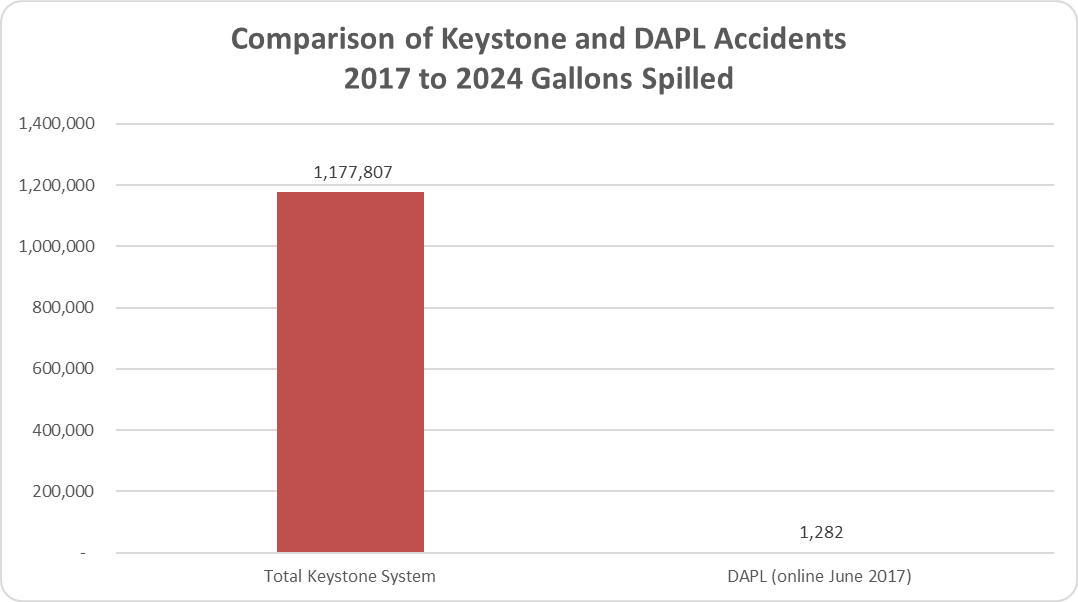
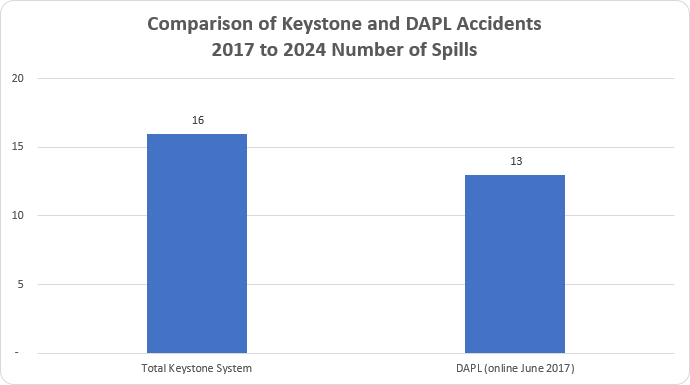
So, how bad is Keystone’s spill record? Let’s compare it to the spill record for Energy Transfer Partners’ Dakota Access Pipeline (DAPL), which came online in 2017, is also a 30-inch diameter pipelines, and was constructed to the same federal specifications. DAPL experienced 13 accidents and spilled 1,282 gallons between June 2017 and the present. Keystone experienced 16 accidents and spilled a whopping 1,177,807 gallons during this same time period.
Keystone spilled 900 times more oil than DAPL over the same period of time. Most pipeline accidents are small, happen in pump stations and other above-ground facilities, and are caused by leaking equipment. Very large spills are almost always the result of a rupture of the pipeline. Keystone has a much higher volume spilled because its pipeline has ruptured multiple times, whereas DAPL has not.
Now granted, the Keystone System at 1,923 miles is 64% longer than DAPL, so we should compare gallons spilled per mile. Doing the numbers, Keystone spilled 536 gallons per mile of pipe between June 2017 and the present. DAPL spilled 1.1 gallons per mile. Keystone’s spill record is still comparatively awful.
If one examines the locations of Keystone’s spills, 1,193,564 gallons were spilled in Keystone’s northern segments (ND, SD, NE, KS, MO, IL, and northern OK), which includes 1,382 miles. Only 19,052 gallons (1.6% of the total spilled) was spilled in its southern segment (southern OK and TX), which includes 571 miles or 30 percent of the total mileage. The northern segment came online in 2010, and the southern segment came online in 2014 using entirely different materials and construction contracts. The spill data suggests that Keystone’s northern segment was poorly constructed.
The northern segment of the Keystone Pipeline has been shown to be a lemon – and when it spills, it ain’t lemonade.